
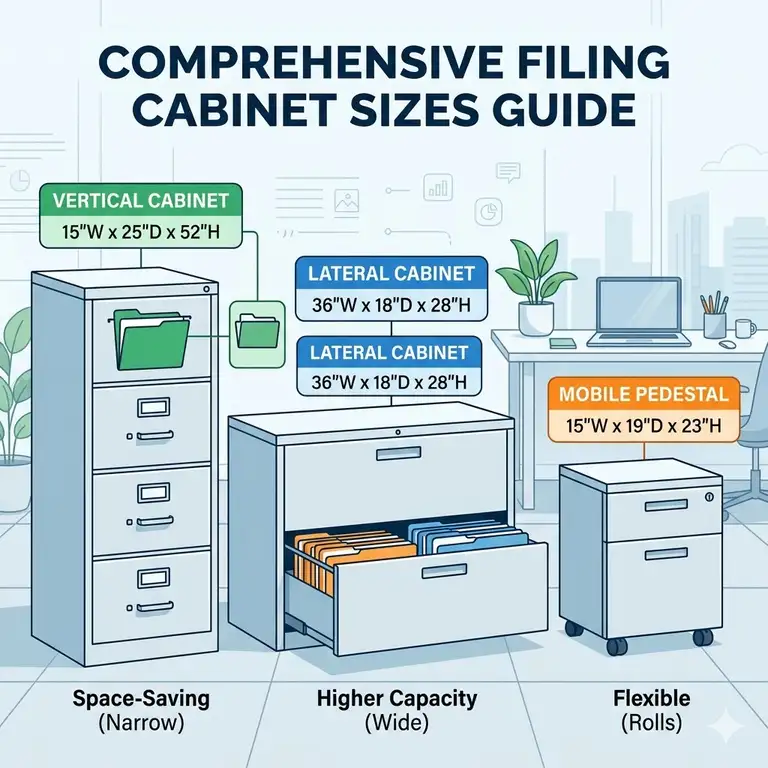
In an era where “paperless” was supposed to be the norm, our physical desks still seem to accumulate a surprising amount of critical documentation. Whether it’s tax records, property deeds, or those “just in case” printouts, managing your physical archives requires a solid understanding of filing cabinet sizes. Choosing the wrong dimensions doesn’t just clutter your room; it actively hampers your productivity by creating bottlenecks in your workflow.
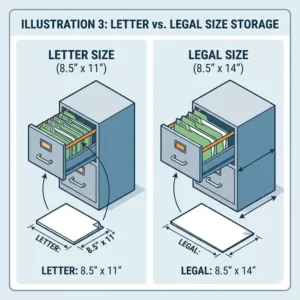
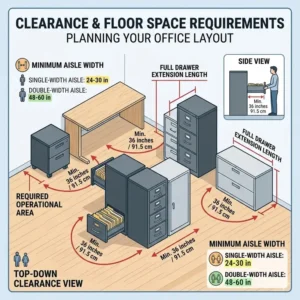
What are filing cabinet sizes? Broadly speaking, they are the standardized external dimensions (width, depth, and height) designed to accommodate specific paper formats, most commonly Letter ($8.5 \times 11$ inches) or Legal ($8.5 \times 14$ inches). While the internal capacity is dictated by the paper, the external footprint varies wildly between vertical, lateral, and flat-file designs. In my experience, most people underestimate the “clearance zone”—the extra 18 to 28 inches needed to actually pull the drawers out—resulting in cramped offices that feel more like obstacle courses.
Navigating the market in 2026 means looking beyond just metal boxes. We now see hybrid designs that blend aesthetics with utility. However, the fundamentals of filing cabinet sizes remain the anchor for any organized office. Understanding how a 15-inch wide vertical unit differs in utility from a 36-inch lateral unit is the first step toward reclaiming your floor space.
Quick Comparison Table: Standard Filing Cabinet Dimensions
| Cabinet Type | Average Width | Average Depth | Average Height (2-Drawer) | Best For |
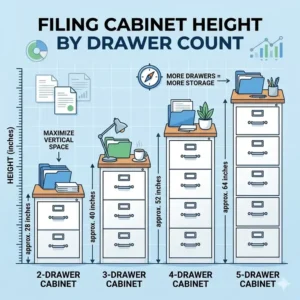
| Vertical (Letter) | 15 inches | 22–28 inches | 28–30 inches | Narrow spaces / Deep storage |
| Vertical (Legal) | 18 inches | 22–28 inches | 28–30 inches | Professional/Law offices |
| Lateral (Standard) | 30–42 inches | 18–20 inches | 28 inches | High-traffic areas / Walkways |
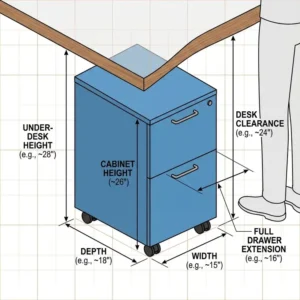
| Mobile/Pedestal | 15 inches | 18–20 inches | 20–27 inches | Under-desk storage / Flex-tech |
| Flat File | 40–50 inches | 30–40 inches | 15–20 inches | Blueprints / Large Art |
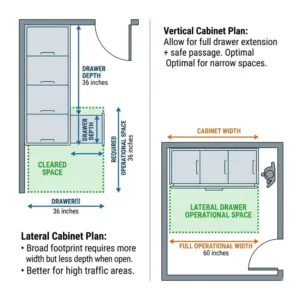
Expert Analysis: Looking at the data above, the most critical trade-off is between depth and width. Vertical cabinets are “space-eaters” in terms of how far they stick out into a room when open, whereas lateral cabinets occupy more wall real estate but offer a shallower profile. For a home office under 100 square feet, the mobile pedestal is almost always the superior choice for versatility.
💬 Just one click — help others make better buying decisions too! 😊
[addtoany]
Top 5 Filing Cabinets: Expert Analysis
Choosing a cabinet based on specs alone is a recipe for regret. Here is my breakdown of the top performers in 2026, analyzed for real-world utility and longevity.
1. DEVAISE 3-Drawer Mobile Slim Cabinet
The DEVAISE 3-Drawer Mobile Slim Cabinet is the gold standard for modern, minimalist setups. It features a sleek, handle-free design and a bottom drawer specifically engineered for high-capacity filing.
-
Key Specs: 11.8″ W x 17.1″ D x 23.6″ H. This “Slim” profile is roughly 3 inches narrower than standard units, making it perfect for tight corners.
-
Expert Opinion: What most buyers overlook is the fifth caster wheel on the bottom drawer. Cheaper models often tip forward when you open a heavy bottom drawer; this design prevents that specific “office catastrophe.” It’s ideal for remote workers who use a height-adjustable desk.
-
Customer Feedback: Users consistently praise the “pre-assembled” nature of the unit, though some note the slim width restricts you to letter-sized files only.
-
Pros:
-
Anti-tip mechanism with 5th wheel.
-
Fits under almost any standard desk height.
-
Full-extension drawers for total access.
-
-
Cons:
-
Not compatible with Legal-sized documents.
-
Metal can feel thin if overloaded.
-
-
Price Range: Around $110–$140.
-
Value Verdict: The best ROI for small home offices where floor space is at a premium.
2. Lorell SOHO 2-Drawer Mobile Vertical
For those needing a balance of traditional filing and mobile flexibility, the Lorell SOHO 2-Drawer Mobile Vertical is a reliable workhorse. It’s deeper than the average mobile unit, offering more linear filing inches.
-
Key Specs: 14.3″ W x 18″ D x 24.5″ H. It accommodates letter-size hanging folders with ease.
-
Expert Opinion: I recommend this for “SOHO” (Small Office/Home Office) users who still deal with a moderate paper trail. The 18-inch depth is the “sweet spot”—it’s deep enough to hold a year’s worth of invoices but shallow enough not to block a doorway.
-
Customer Feedback: Reviewers mention the lock is basic but functional for keeping curious kids or roommates out of private documents.
-
Pros:
-
Lightweight and easy to move on carpet.
-
Lockable top drawer for privacy.
-
Very budget-friendly.
-
-
Cons:
-
Slides are non-ball-bearing, so it’s noisier.
-
Drawers don’t pull out 100% of the way.
-
-
Price Range: $70–$95 range.
-
Value Verdict: Excellent entry-level cabinet for students or freelancers.
3. Bush Furniture Key West 2-Drawer Lateral
The Bush Furniture Key West 2-Drawer Lateral moves away from the “industrial” look and into the “home furniture” category. It’s designed to look like a high-end end table while hiding a full filing system.
-
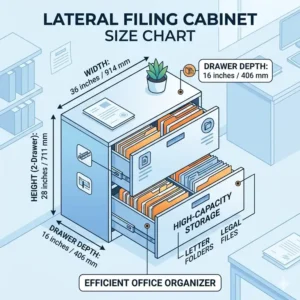
Key Specs: 30″ W x 20″ D x 30″ H. It supports both Letter and Legal size documents using adjustable rails.
-
Expert Opinion: This is a “lifestyle” cabinet. If your office is in your living room, you don’t want a gray metal box. The lateral design allows you to use the top surface for a printer or a lamp, effectively doubling its utility.
-
Customer Feedback: High marks for aesthetics, though assembly takes roughly 90 minutes.
-
Pros:
-
Beautiful “X” pattern accents and multiple finishes.
-
Full-extension ball-bearing slides (very smooth).
-
Accommodates Legal-sized files laterally.
-
-
Cons:
-
Heavy (requires two people to move).
-
Assembly is complex for beginners.
-
-
Price Range: $180–$230 range.
-
Value Verdict: The premier choice for aesthetics-focused professionals.
4. Hirsh Industries 22-Inch Deep Pro Vertical
When you mean business, you buy Hirsh. The Hirsh Industries 22-Inch Deep Pro Vertical is built for high-volume commercial use but fits surprisingly well in a dedicated home study.
-
Key Specs: 15″ W x 22″ D x 28.4″ H. Features commercial-grade steel construction.
-
Expert Opinion: The 22-inch depth is the “pro” standard. While home models are often 18 inches, that extra 4 inches of depth provides roughly 20% more filing capacity per drawer. If you are an accountant or lawyer, this is the minimum spec you should consider.
-
Customer Feedback: Users love the “industrial” durability; this is a cabinet that will last 20 years.
-
Pros:
-
High-side drawers (no need for extra hanging rails).
-
Precision ball-bearing slides.
-
Core-removable lock for fleet keying.
-
-
Cons:
-
Industrial look isn’t for everyone.
-
Sharp metal edges on the back (careful with wallpaper).
-
-
Price Range: Around $160–$190.
-
Value Verdict: Best “cost-per-year” value; it’s virtually indestructible.
5. Christopher Knight Home Odelia Mid-Century Cabinet
The Christopher Knight Home Odelia Mid-Century Cabinet proves that filing cabinet sizes can be stylish. It uses a wood-veneer finish and tapered legs to offer a retro vibe.
-
Key Specs: 19″ W x 16″ D x 26″ H. A unique “hybrid” size that’s wider than a vertical but narrower than a lateral.
-
Expert Opinion: This model is perfect for “light filing.” If you only have a few folders but want a piece that starts a conversation, this is it. However, the tapered legs mean it has a higher center of gravity—don’t overload the top drawer while the bottom is empty.
-
Customer Feedback: Commended for its solid wood feel and mid-century modern accuracy.
-
Pros:
-
Unique design that complements high-end decor.
-
Compact footprint for studio apartments.
-
Sturdy construction.
-
-
Cons:
-
Limited filing capacity compared to metal units.
-
Not designed for heavy daily use.
-
-
Price Range: In the mid-$200s.
-
Value Verdict: A “statement piece” for those who prioritize design over bulk storage.
✨ Don’t Miss These Exclusive Deals!
🔍 Take your organization to the next level with these carefully selected products. Click on any highlighted item to check current pricing and availability. These tools will help you create an authentic workspace your family will love!
Real-World Scenario: Which Size Fits Your Life?
Understanding filing cabinet sizes is easier when you visualize how they fit into a specific lifestyle. Let’s look at three common profiles I’ve encountered.
The “Compact Apartment” Freelancer
-
Environment: 600 sq. ft. apartment, desk in the bedroom.
-
Needs: Privacy for contracts, small footprint, mobility.
-
Recommendation: A Mobile Pedestal (15″ W x 18″ D).
-
Why: You can wheel it under your desk when the workday ends, reclaiming floor space. Since you likely digitize 90% of your work, the smaller capacity isn’t a dealbreaker.
The “Work-from-Home” Professional (Accountants/Lawyers)
-
Environment: Dedicated home office with significant paper requirements.
-
Needs: High-volume storage, Legal-size compatibility, durability.
-
Recommendation: A 4-Drawer Vertical (18″ W x 25-28″ D).
-
Why: You need the “linear filing inches.” Vertical cabinets provide the most storage per square foot of wall space. The extra depth allows you to store decades of records in a single corner.
The “Family Command Center”
-
Environment: High-traffic kitchen or hallway nook.
-
Needs: Easy access for multiple people, aesthetic appeal, surface area.
-
Recommendation: A 2-Drawer Lateral (30-36″ W x 18″ D).
-
Why: Lateral cabinets are shallower (18″ deep vs 28″), meaning they don’t stick out into the hallway as much. The wide top serves as a perfect spot for the family charging station or mail organizer.
Buyer’s Decision Framework: The “Wait, Don’t Buy Yet” Checklist
Before you hit “buy” on that shiny new cabinet, walk through this priority checklist. I’ve seen too many people buy a cabinet only to realize their “Legal” folders don’t fit.
-
Measure Your Folders First: Do you use Letter ($8.5 \times 11$) or Legal ($8.5 \times 14$)? A “Letter” cabinet will physically not hold a “Legal” folder. Most Legal cabinets can be adjusted to hold Letter, but the reverse is rarely true.
-
Calculate the “Draw Path”: Take the depth of the cabinet (e.g., 28 inches) and add 20 inches. That is the total clearance you need. If you have a chair in the way, you’ll be doing “the shimmy” every time you need a file.
-
Weight Capacity vs. Floor Type: A full 4-drawer lateral cabinet can weigh over 400 lbs. On a plush carpet, the wheels on a mobile unit will dig in and refuse to move. On old hardwood, a heavy metal base might leave permanent indentations. Consider a floor mat.
-
Security Level: Are you storing birth certificates and deeds, or just old utility bills? If it’s the former, look for “UL Rated” fireproof cabinets. Be warned: fireproof filing cabinet sizes are significantly larger (thicker walls) with much smaller internal capacity.
-
The “Topper” Potential: Can you put a printer on it? If yes, look for a cabinet height between 27 and 30 inches. Anything taller makes the printer awkward to reach; anything shorter (like mobile units) might be too low for comfortable use.
How to Choose the Right Filing Cabinet Sizes
Choosing the right size is a mathematical exercise disguised as a decor choice. First, audit your current paper pile. One standard drawer holds about 150–200 full folders. If you have 500 folders, a 2-drawer unit will be overflowing by next Tuesday.
Second, consider the “Expansion Factor.” In my experience, physical archives grow by about 10% annually even in digital environments. Buy 20% more capacity than you currently need. This prevents the “overstuffed drawer” syndrome where you can’t actually see the tabs on your folders.
Third, look at the width. If you have a long, empty wall, Lateral is your friend. If you have a tiny gap between a desk and a bookshelf, Vertical is the winner. Vertical cabinets are like skyscrapers—they use verticality to solve space issues. Lateral cabinets are like ranch houses—they spread out but are easier to navigate.
Vertical vs. Lateral: The Great Debate
The choice between vertical and lateral is the most significant decision in your purchase journey.
Vertical Cabinets are the traditional choice. They are usually 15 inches wide (for letter) or 18 inches wide (for legal). The folders face the front of the drawer.
-
Analysis: These are best for deep storage. However, they require a lot of “pull-out” space. If you put a vertical cabinet in a hallway, you will completely block the path when you open it.
Lateral Cabinets are wider, typically 30, 36, or 42 inches. The folders can be arranged side-to-side or front-to-back.
-
Analysis: They are only 18-20 inches deep. This “shallow” profile is why they are popular in modern office designs. You can line a whole wall with them without making the room feel narrow. Plus, they offer more “top surface” for office equipment.
What to Expect: Real-World Performance
When you first unbox a cabinet, the “spec sheet” performance often differs from daily use. For example, a cabinet listed as “22 inches deep” might only have 19 inches of usable filing space because of the drawer back and the slide mechanism.
Furthermore, “ball-bearing slides” are a feature you should never skip. In 2026, friction-based slides (metal sliding on metal) are mostly found in ultra-budget models. They are noisy, they catch, and if the cabinet is slightly unlevel, the drawers will either fly open or refuse to stay shut. Ball-bearing slides provide that “weighted luxury” feel and usually include a “stay-closed” feature that prevents accidental opening.
Lastly, consider the weight of the paper. Paper is surprisingly heavy. A drawer full of legal files can weigh 60–80 lbs. If your cabinet doesn’t have an “interlocking drawer system” (which prevents more than one drawer from opening at a time), it becomes a tipping hazard. Always look for this safety feature in any unit taller than two drawers.
Common Mistakes When Buying Filing Cabinet Sizes
The #1 mistake? Measuring the cabinet but not the clearance. I’ve consulted for dozens of home offices where the buyer bought a beautiful 28-inch deep vertical cabinet, only to realize their desk chair hits the cabinet when the drawer is only halfway open. Always measure the “fully extended” length.
Another pitfall is ignoring the “Hanging Folder Rail” requirement. Some “furniture-style” cabinets don’t come with the metal rails needed to hang folders. You’re then forced to buy a separate “hanging rack” insert, which often doesn’t fit the internal filing cabinet sizes perfectly, leading to wasted space and folders falling off the track.
Finally, don’t buy “Cheap Metal.” In the world of filing cabinets, weight is often a sign of quality. A 2-drawer cabinet that weighs only 15 lbs is made of thin gauge steel that will warp under the weight of actual files. Look for “commercial grade” or “22-gauge” steel if you want something that won’t dent if you accidentally bump it with your vacuum.
Long-Term Cost & Maintenance
A filing cabinet is a “buy it once” item, but only if you maintain it. The ROI on a $200 cabinet over 20 years is $10/year—far cheaper than a digital storage subscription. To ensure longevity, never “slam” the drawers. Even the best ball-bearing slides can be knocked out of alignment by brute force.
Once a year, vacuum the tracks. Dust and hair (especially if you have pets) can gum up the lubricant on the bearings, making the drawers feel sluggish. If a drawer starts to squeak, a tiny amount of white lithium grease on the tracks will make it feel brand new.
From a cost perspective, remember that the cabinet is only half the expense. You also need hanging folders ($0.50–$1.00 each) and manila inserts. If you buy a “Lateral” cabinet, you might need “cross-rails” to file front-to-back, which are often sold separately. Factor these “hidden” costs into your budget.
✨ Don’t Miss These Exclusive Deals!
🔍 Take your organization to the next level with these carefully selected products. Click on any highlighted item to check current pricing and availability. These tools will help you create an authentic workspace your family will love!
Conclusion
Mastering filing cabinet sizes is about balancing your current paper volume with the physical constraints of your room. Whether you opt for a sleek, mobile DEVAISE unit that tucks away after work or a robust Hirsh vertical for heavy-duty archiving, the key is to measure twice and buy once. In 2026, your office storage should work for you, not against you. By choosing a cabinet that fits your “draw path” and folder needs, you create a frictionless environment where organization happens naturally.
FAQs
❓ What is the most common filing cabinet size for home use?
✅ The 2-drawer mobile pedestal (approx. 15″ W x 18″ D x 24″ H) is the most popular. It’s sized to fit under standard desks, providing enough storage for personal taxes and medical records without occupying extra floor space…
❓ Can I store legal folders in a letter-sized cabinet?
✅ No. A letter-sized cabinet is roughly 15 inches wide, while legal folders require at least 18 inches of width (in vertical cabinets). Trying to cram legal paper into a letter drawer will damage the documents and jam the mechanism…
❓ How much space do I need in front of a filing cabinet?
✅ You should allow for the depth of the cabinet plus at least 20 inches. For a standard 28-inch vertical cabinet, this means you need 48 inches of total clear floor space to fully extend the drawers and stand in front of them…
❓ Are lateral filing cabinets better than vertical ones?
✅ “Better” depends on your room layout. Lateral cabinets are superior for narrow rooms or walkways because they are shallower. Vertical cabinets are better for high-density storage where you have limited wall width but plenty of depth to spare…
❓ What does “full extension” mean in cabinet specs?
✅ Full extension means the drawer pulls out far enough that you can easily reach the very last folder at the back. Some “three-quarter extension” models leave 4–5 inches of the drawer inside the cabinet, making those rear files difficult to access…
Recommended for You
- 5 Best two drawers file cabinet Models for 2026: Organize with Style
- 5 Best Dark Wood 2 Drawer File Cabinet Options for 2026 Home Offices
- 7 Best Home Office Filing Cabinets Wood for 2026: Organize in Style! Booyah!
Disclaimer: This article contains affiliate links. As an Amazon Associate, I earn from qualifying purchases. If you purchase products through these links, we may earn a small commission at no additional cost to you.
✨ Found this helpful? Share it with your friends! 💬🤗
[addtoany]
