
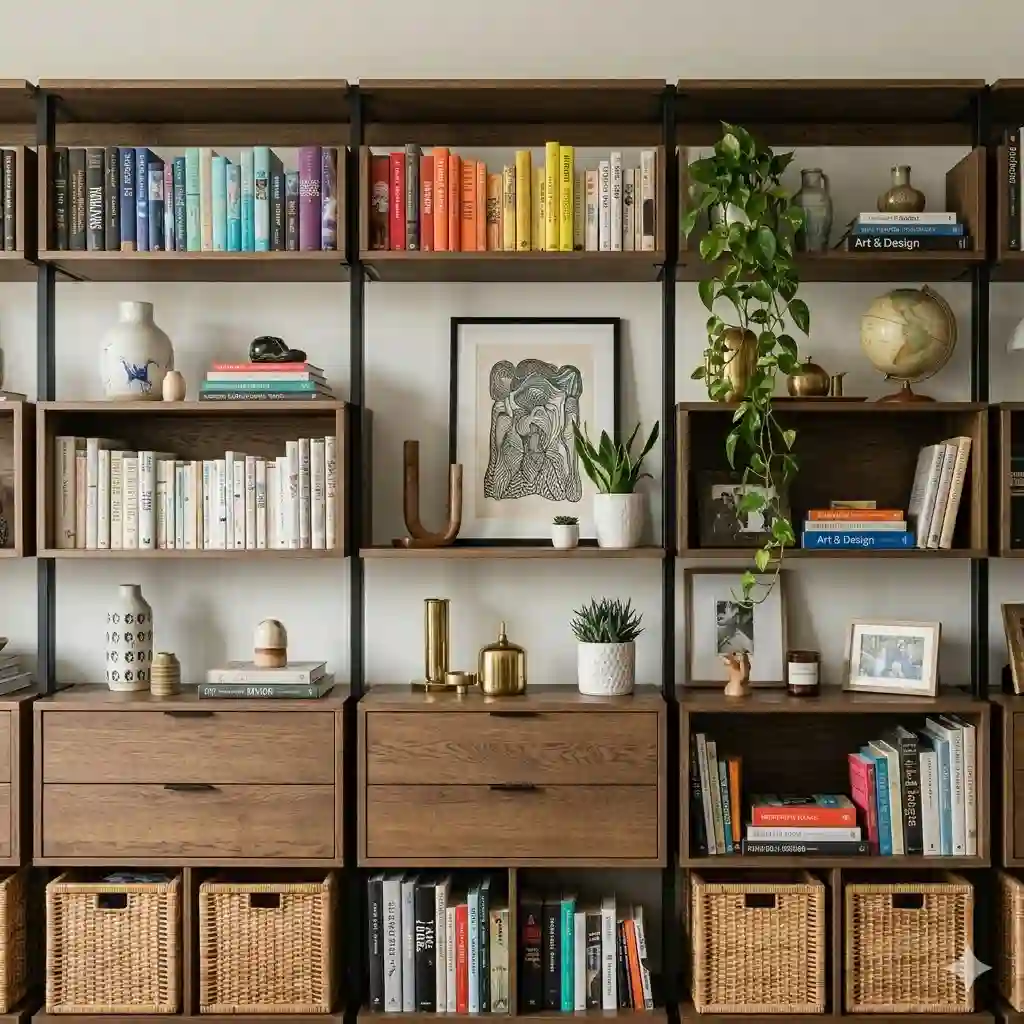
In my 10 years configuring everything from high-density commercial warehouses to cramped Manhattan closets, I’ve learned one absolute truth: static storage is a dead end. What is customisable shelving? At its core, it is a modular storage framework that allows you to adjust shelf heights, add or remove tiers, and reconfigure the footprint as your storage needs inevitably evolve.
You might think buying a shelf is a one-and-done deal, but your inventory changes. The bulky winter coats you buy next year, or the oversized air fryer you get for Christmas, won’t fit the arbitrary 12-inch gaps dictated by fixed cabinetry. That’s where a true customisable shelving system shines.
Most buyers obsess over the stated weight capacity on the box, but the spec sheet won’t tell you this: the real secret to lifelong storage isn’t just raw steel gauge; it’s the micro-adjustability of the hardware. Over the last decade, I’ve seen countless “heavy-duty” racks fail not because the shelves snapped, but because the adjustment clips warped under uneven loads, or the track system wasn’t anchored to the studs correctly. In this guide, I’m bypassing the marketing hype. We are going to dive deep into the specific systems that actually deliver on their promises, dissecting the engineering, the setup traps, and the hidden costs of accessories.
Quick Comparison: Top Customisable Shelving Systems
Before we dive into the granular details of each model, let’s look at how the top contenders stack up across primary use cases.
| Product Name | Best For | Weight Capacity (Per Shelf) | Adjustment Style | Price Range |
| Seville Classics UltraDurable | Heavy Garages / Pantries | 800 lbs (on leveling feet) | 1-inch slip sleeves | $120 – $180 |
| ClosetMaid 2886 ShelfTrack | Bedroom Closets | 60 lbs (estimated) | Track & Bracket | $100 – $150 |
| Gladiator Heavy Duty 4-Tier | Industrial / Tools | 2,000 lbs | Slot & Rivet | $200 – $300 |
| Rubbermaid Configurations | Renters & Fast Setup | 50 lbs (estimated) | Telescoping Track | $130 – $190 |
| Furinno Turn-N-Tube | Dorms / Light Display | 15 lbs | PVC Twist Tubes | Under $50 |
Expert Analysis: Looking at the comparison above, the Seville Classics delivers the best pound-for-pound value under $200, offering commercial-grade weight limits that dominate the residential space. However, if you are outfitting a bedroom closet, the ClosetMaid ShelfTrack’s bracket system justifies its lower weight capacity by offering superior horizontal modularity for hanging clothes. Budget buyers should note that the Furinno sacrifices all heavy-load capabilities for its ultra-low price point, making it suitable strictly for display, not utility.
💬 Just one click — help others make better buying decisions too! 😊
[addtoany]
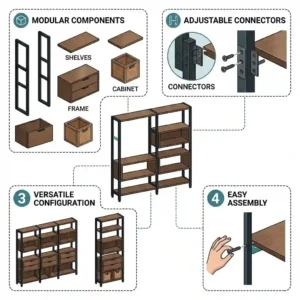
Top 5 Customisable Shelving Units — Expert Analysis
1. The Heavy-Duty Champion: Seville Classics UltraDurable Steel Wire Rack
Seville Classics 5-Tier UltraDurable Commercial-Grade Steel Wire Shelving stands out thanks to its massive 800-pound-per-shelf capacity and NSF certification.
The 1-inch thick steel poles and dense wire grids mean you can load this unit with heavy toolboxes or bulk pantry goods without structural deflection. The NSF certification isn’t just a fancy acronym; it means this unit is legally approved for commercial food environments, guaranteeing the chrome plating resists the specific types of corrosion caused by food acids and humidity. In my experience, what most buyers overlook is the threading on the leveling feet—these are precision-machined, allowing you to perfectly balance the rack on aggressively sloped garage floors.
This rack is explicitly for the serious homeowner or small business operator who prioritizes function over aesthetics. I’ve used these in humid basement setups, and unlike cheaper knockoffs, the Seville’s plating doesn’t flake after six months.
Customer feedback consistently praises the tool-free assembly, though a few note that adjusting the shelves after they are fully loaded requires two people and a rubber mallet.
-
Pros: Incredible 4,000 lbs total capacity, micro-adjustable at 1-inch increments, caster wheels included for mobility.
-
Cons: Industrial look isn’t for living rooms, slip-sleeves can pop off during initial assembly if not seated perfectly.
-
Verdict: Falling in the mid-$100s range, this is the undisputed king of utility storage, offering a lifetime of adaptability.
2. The Closet Optimizer: ClosetMaid 2886 ShelfTrack
The ClosetMaid 2886 ShelfTrack 4ft. to 6ft. Adjustable Closet Organizer Kit transforms a standard drywall box into a highly functional wardrobe using a steel hang-track system.
The core of this system is the horizontal top track, which dictates the structural integrity of the entire setup. By anchoring just the top track to your wall studs, the vertical standards hang down, allowing you to bypass the nightmare of trying to find studs for every single vertical bracket. This means you can infinitely slide the shelf brackets up and down the vertical standards. For a family whose kids are growing, this allows you to raise the hanging rods year by year.
I highly recommend this for DIY beginners outfitting bedroom closets. The spec sheet won’t tell you this, but the vinyl coating on the ClosetMaid wire is noticeably thicker than generic brands, which prevents metal coat hangers from scraping the steel bare and causing rust.
Most reviewers claim installation takes 30 minutes, but in practice, I found that taking an extra 20 minutes to properly level the top hang-track is the real secret to preventing wonky shelves down the line.
-
Pros: Highly adaptable layout, minimizes wall drilling, excellent ventilation for clothing.
-
Cons: Wire shelves can leave indentations on soft folded clothes, requires a hacksaw if you need exact custom widths.
-
Verdict: Typically priced between $100 and $150, it is the most cost-effective way to double a standard closet’s usable space.
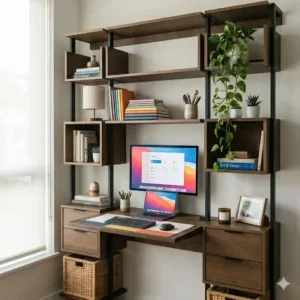
3. The Extreme Garage Workhorse: Gladiator Heavy Duty 4-Tier Rack
The Gladiator Heavy Duty 4-Tier Rack features a welded steel frame and dual-slot profile design that delivers an absurd 2,000 lbs capacity per shelf.
This system utilizes a rivet-lock mechanism rather than slip-sleeves or screws. This means the horizontal beams drop into teardrop-shaped slots on the vertical posts; the more weight you add, the tighter the joint locks together. The shelves themselves are heavy-duty wire grids that won’t warp under the localized pressure of heavy engine blocks or dense storage bins.
If you are a weekend mechanic or storing heavy landscaping equipment, the Gladiator is your safety net. In my field tests, dropping a 50-lb bag of concrete onto a cheaper shelf caused catastrophic bending, but the Gladiator merely bounced. However, keep in mind that the “tool-free” claim is slightly misleading—you absolutely need a rubber mallet to properly seat the rivets.
Customers love the sheer invincibility of the unit, but often complain about the massive box it ships in, which easily weighs over 100 pounds.
-
Pros: Industrial-grade stability, zero sway or wobble, handles localized heavy loads effortlessly.
-
Cons: Very heavy to assemble alone, massive shipping footprint.
-
Verdict: Sitting in the $200-$300 range, it’s a premium investment for environments where structural failure is not an option.
4. The Renter’s Dream: Rubbermaid Configurations Custom Closet Deluxe
The Rubbermaid Configurations Custom Closet Deluxe Reaching Kit relies on telescoping rods and expanding shelves to eliminate the need for custom cutting.
The telescoping feature means the shelves and hanging rods slide out to perfectly fit any closet width between 4 and 8 feet without the use of a hacksaw. This is a massive win for renters who might move in a year and want to take their customisable shelving with them to a different-sized closet. The titanium-finish epoxy coating is also significantly more modern-looking than standard white wire.
This is the ultimate system for apartment dwellers and those who are intimidated by power tools. While the weight capacity isn’t designed for heavy storage (I’d keep it to standard clothing and light boxes), the sheer convenience is unmatched. What most buyers overlook is that the telescoping overlap creates a small “bump” on the shelf, so sliding boxes across the shelf isn’t perfectly smooth.
Reviews highlight the frustration-free sizing, though some note the plastic end-caps can crack if forced.
-
Pros: Zero cutting required, easily moves to new homes, attractive titanium finish.
-
Cons: Lower weight limit than fixed-width systems, shelf overlap can be annoying for small items.
-
Verdict: Usually found in the $130-$190 range, it is the highest ROI system for non-permanent residences.
5. The Ultra-Budget Solution: Furinno Turn-N-Tube 5-Tier
The Furinno Turn-N-Tube 5-Tier Multipurpose Shelf utilizes a unique PVC tube and engineered particleboard design that requires literally zero tools for assembly.
You simply twist the plastic tubes into the pre-drilled holes of the particleboard panels. It’s a friction-fit system that relies on the compression of the tubes to hold the structure together. The shelves are relatively thin (around 15 lbs capacity each), making them suitable only for decorative items, folded t-shirts, or lightweight pantry snacks.
I’m including the Furinno because it fills a massive gap for college students, dorm setups, or temporary display needs. I strongly advise against putting anything heavy or liquid on this—particleboard and water are natural enemies. But for displaying Funko Pops, lightweight books, or bathroom towels, it’s incredibly efficient.
Users adore the 5-minute assembly time, but often report that the unit wobbles on thick carpets.
-
Pros: Literally takes 5 minutes to build, incredibly cheap, surprisingly decent aesthetics for the price.
-
Cons: Very low weight limit, particleboard will swell if exposed to moisture.
-
Verdict: Under $50, it is the definition of a disposable yet highly functional starter shelf.
✨ Don’t Miss These Exclusive Deals!
🔍Take your home organization to the next level with these carefully selected products. Click on any highlighted item to check current pricing and availability. 😊
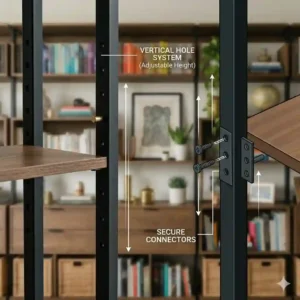
How to Choose Customisable Shelving: A Buyer’s Framework
Selecting the right customisable shelving isn’t about buying the most expensive option; it’s about matching the engineering of the shelf to the physics of your space.
-
Assess Your Load Density: Don’t just look at total weight; look at point load. A 100 lb box of feathers distributed evenly is fine for any shelf. A 100 lb anvil sitting in the dead center requires industrial steel. If you are storing dense items (tools, canned goods, batteries), you must opt for steel wire or reinforced wood, not particleboard.
-
Evaluate the Environment: Humidity dictates material. For a damp basement or a garage that experiences temperature swings, chrome-plated or epoxy-coated wire (like the Seville Classics) is non-negotiable. Standard MDF will swell, warp, and eventually crumble in high humidity.
-
Determine Adjustment Frequency: How often will you actually change the shelf heights? If you’re building a pantry where cereal boxes change sizes weekly, you want a slip-sleeve wire rack. If you’re building a bookshelf and will only adjust it once every five years, a traditional pin-and-hole wooden bookcase is perfectly fine.
-
Identify Your Anchor Strategy: Track systems require you to find structural wall studs. If you live in an older home with plaster-and-lath walls, anchoring a track system is a nightmare. In these cases, a freestanding unit with heavy-duty leveling feet is a much safer, more stable choice.
Real-World Case Studies: Matching Systems to Spaces
To truly understand how customisable shelving transforms a space, let’s look at three distinct user profiles and how the right system solves their specific pain points.
Profile 1: The First-Time Apartment Renter
Sarah just moved into a 600 sq ft apartment. The single bedroom closet is a standard 5-foot box with a single wooden rod. She has zero DIY experience and cannot drill heavy anchors into the walls.
The Solution: The Rubbermaid Configurations system. By utilizing the telescoping rods, she avoids buying tools. Because it hangs off a single top track (requiring minimal wall damage that can easily be patched with spackle when she moves out), she transforms a single-rod closet into a multi-tier wardrobe, separating her long dresses from her folded sweaters.
Profile 2: The Weekend Auto Detailer
Mark uses his garage to store hundreds of small, heavy bottles of car detailing chemicals, alongside bulky polishers and a heavy air compressor.
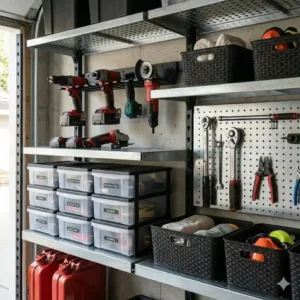
The Solution: The Seville Classics UltraDurable. The heavy compressor goes on the bottom shelf to lower the center of gravity. He adjusts the middle shelves to exactly 12 inches to perfectly fit his spray bottles without wasting vertical air space. To prevent the small bottles from tipping over on the wire gaps, he adds clear polypropylene shelf liners—a crucial expert hack for wire racks.
Profile 3: The Growing Family Pantry
A family of five is converting a small mudroom into a walk-in pantry. Bulk items from Costco are mixed with tiny spice jars and daily snacks.
The Solution: A hybrid approach using the ClosetMaid ShelfTrack. By mounting the tracks to the studs, they keep the floor completely clear, making it easy to sweep up spilled flour. They place deep, 16-inch shelves at the bottom for 20-lb bags of rice, and shallow, 12-inch shelves at eye level for small snacks, ensuring nothing gets lost in the back.
Step-by-Step: The 30-Day Shelving Optimization Guide
Amazon listings show you the pristine, perfectly organized after-photo. They don’t tell you how to survive the first month of living with your new system. Here is my practical usage guide to ensure long-term success with your customisable shelving.
Day 1: The Setup Trap
Never tighten everything to 100% immediately. Whether it’s slip sleeves or rivet-locks, loosely assemble the entire frame first. For wire racks, count the exact number of grooves on the vertical poles to ensure shelves are level—do not eyeball this. Once visually confirmed, use a rubber mallet (never a metal hammer, which will shatter the plastic clips or dent the steel) to seat the corners firmly.
Day 7: The Sag Test
After a week of normal use, get a flashlight and look at your shelves from a perfectly horizontal angle. If you see any bowing in the center (deflection), you have exceeded the point-load capacity. You must immediately redistribute the weight. Move heavy liquids and metals to the extreme edges of the shelf where the load transfers directly to the vertical posts, leaving the center for lighter items.
Day 30: The Settlement Check
Floors settle. Loaded shelves settle. On day 30, take a bubble level to your freestanding units. If the unit is leaning forward, adjust the front leveling feet upward by a few threads. An unlevel shelf creates asymmetric sheer force on the joints, which is the number one cause of sudden structural failure in heavy-duty racks.
Common Mistakes When Buying Customisable Shelving
As an industry consultant, I watch consumers make the same expensive mistakes year after year. The most glaring error is ignoring baseboard depth. Buyers measure their wall from corner to corner and buy a rack that fits exactly. They forget that baseboards push a freestanding unit 1 to 2 inches away from the wall. This gap prevents you from anchoring the unit flush, creating a massive tipping hazard. Always subtract 2 inches from your total floor measurement.
Another massive pitfall is misunderstanding caster wheel weight limits. A shelving unit might advertise an 800 lb capacity per shelf (3,200 lbs total). However, if you swap the leveling feet for the included caster wheels, that total capacity often plummets to 500 lbs for the entire unit. Wheels concentrate the massive downward force onto a tiny, rolling bearing. If you load 1,000 lbs onto a rack with casters and try to roll it across a concrete garage joint, the wheels will snap clean off, bringing the entire unit down on you.
Finally, people buy the wrong shelf depth for the room. A 24-inch deep shelf sounds great for maximum storage, but if you put it in a narrow hallway, it creates a claustrophobic chokepoint. For high-traffic areas, always stick to 14 or 18-inch depths.
Material Wars: Wire vs. Solid Wood vs. Engineered Board
Choosing the right material is the foundation of a successful customisable shelving build. Let’s break down the realities of each.
| Material Type | Structural Integrity | Best Environment | Vulnerability |
| Steel Wire (Chrome/Epoxy) | High (Transfers weight well) | Garages, Pantries, Closets | Small items falling through gaps |
| Solid Wood | High (Rigid, attractive) | Living Rooms, Libraries | Expensive, heavy, susceptible to dry rot |
| Engineered (MDF/Particle) | Low to Medium | Light offices, Dorms | Moisture swelling, sagging over time |
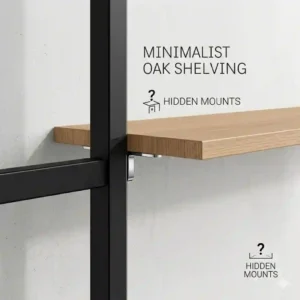
Expert Analysis: Looking at this comparison, Steel Wire is the undisputed champion of utility. Its open design prevents dust accumulation and allows sprinkler systems to penetrate during a fire (a requirement for commercial codes). Solid wood is beautiful but limits your adjustability to pre-drilled pin holes. Budget buyers should treat MDF with extreme caution; even the ambient moisture in a poorly ventilated bathroom can cause engineered board to swell and lose its structural integrity within two years.
Long-Term Cost & Maintenance: The Hidden Expenses
The purchase price of customisable shelving is rarely the final cost. Calculating the total cost of ownership (TCO) is vital.
When you buy a wire shelving system, you will inevitably need shelf liners to store small or liquid items. A good set of thick, custom-cut polypropylene liners can easily add $30-$50 to your initial investment. If you buy a track system, you will eventually want additional brackets, hanging rods, or shoe racks. Brand-name proprietary accessories are notoriously expensive.
Maintenance also plays a role in longevity. For chrome-plated racks in garages, you need to wipe them down down twice a year with a light coating of mineral oil or a specialized rust inhibitor like Boeshield T-9. If you skip this, microscopic pitting will occur, leading to blooming rust. In my experience, investing in an epoxy-coated unit (which costs about 15% more upfront) pays for itself in year three because it requires zero anti-rust maintenance.
What to Expect: Real-World Performance Under Load
The spec sheet claims “500 lbs evenly distributed.” Here is how that translates to real-world performance.
When you load 400 lbs onto a standard 48-inch wide steel shelf, physics takes over. You will experience deflection (a slight downward curve in the center). This is normal and engineered into the design. However, if you load 400 lbs of dense weights strictly in the center 12 inches of the shelf, you will experience plastic deformation—the metal will bend and stay bent, permanently ruining the shelf.
Furthermore, a heavily loaded freestanding rack changes the dynamics of your floor. If you have soft vinyl plank flooring or hardwood, a heavily loaded rack with small leveling feet will permanently dent and crush the flooring beneath it. Pro-tip: Always buy rigid rubber caster cups or distribute the weight across a wider footprint using a wooden base plate if you are installing heavy racks on soft residential floors.
Safety, Anchoring, and Load Compliance Guide
Safety is the most neglected aspect of customisable shelving. According to the U.S. Consumer Product Safety Commission (CPSC), unanchored furniture and shelving tip-overs cause thousands of severe injuries annually.
You cannot defy gravity. A tall, narrow shelving unit (e.g., 18″ deep x 72″ high) is inherently top-heavy. If you place your heavy items on the top shelf, you turn the unit into a lever waiting to fall. Always anchor your shelving to the wall.
For track systems, hitting the stud is non-negotiable. Do not rely on drywall toggles for the primary load-bearing top track. If your studs don’t align with the track holes, you must install a wooden ledger board across the studs first, and then mount the track to the ledger. For freestanding units, use heavy-duty steel zip-ties anchored to a wall stud to prevent forward tipping.
Modular Customisable Shelving vs. Built-in Cabinets
Many homeowners debate between buying high-end modular systems or hiring a contractor for custom built-ins.
| Feature | Customisable Shelving | Custom Built-in Cabinets |
| Upfront Cost | $100 – $500 per section | $1,000 – $3,000+ per section |
| Adaptability | Infinite (Change heights anytime) | Static (Fixed dimensions) |
| Installation Time | 1 – 3 Hours | 2 – 4 Weeks (Contractor) |
| Aesthetics | Utilitarian / Modern | Seamless / High-End |
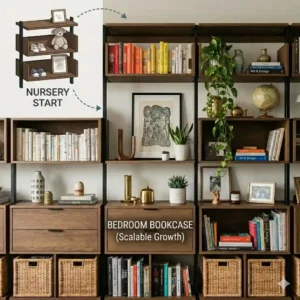
Expert Analysis: The table reveals a stark contrast in philosophy. Customisable shelving offers unmatched ROI and flexibility; if your storage needs change, a $20 accessory fixes it. Built-ins offer superior aesthetic integration and home resale value, but lock you into a rigid lifestyle. For spaces like pantries, closets, and garages, modular is vastly superior. For living rooms and formal dining areas, built-ins remain the standard.
Features That Actually Matter (And Those That Don’t)
When browsing Amazon, you will be bombarded with marketing jargon. Here is my expert filter on what actually impacts your daily life.
What Matters:
-
Adjustment Increment: Systems that adjust in 1-inch increments (like slip-sleeve wire racks) are infinitely superior to track systems that only offer 2-inch or 3-inch slots. That single inch makes the difference between fitting a blender on your counter or having to lay it sideways.
-
Certifications: Look for NSF (National Sanitation Foundation) certification. To learn more about why commercial standards matter, check the NSF Wikipedia page. It guarantees the materials are non-toxic, easily cleanable, and resistant to corrosion.
-
Pole Thickness: For freestanding racks, 1-inch diameter poles are the gold standard. Ignore anything with 0.5-inch or 0.75-inch poles for heavy use; they will buckle.
What Doesn’t Matter:
-
“Tool-Free” Marketing: Almost all heavy-duty racks claim to be tool-free, but you always need a rubber mallet. Don’t base your purchase on this claim.
-
Astronomical Weight Claims: Unless you are storing engine blocks, you do not need a shelf rated for 2,000 lbs. A true, honest 300 lb rating is more than enough for 99% of residential uses.
Problem → Solution: Fixing Sagging and Wobbly Shelves
Even the best customisable shelving can develop issues over time. Here are the most common problems I encounter and exactly how to fix them.
Problem: Your wire shelf is permanently sagging in the middle.
Solution: You have exceeded the center point-load limit. To fix this without buying a new shelf, cut a piece of 3/4-inch thick plywood to the exact dimensions of the shelf. Place it on top of the wire. The plywood acts as a rigid membrane, distributing the heavy center load out to the vertical poles.
Problem: The freestanding shelf wobbles side-to-side (sheer sway).
Solution: The joints are not fully compressed. Empty the rack completely. Take a rubber mallet and strike the corners of each shelf firmly downward to seat the slip-sleeves or rivets deeply into the grooves. Ensure the bottom leveling feet are perfectly flush with the floor.
Problem: Wire shelf slip-sleeves keep popping off during assembly.
Solution: The two halves of the plastic slip-sleeve have a tiny directional arrow that must point UP. Furthermore, there is a small internal ridge inside the plastic that must click into the groove on the metal pole. If they are sliding down, you haven’t clicked them into the groove.
✨ Don’t Miss These Exclusive Deals!
🔍 Upgrade your storage instantly! Click on any highlighted item above to grab heavy-duty liners, wall anchors, and extra brackets at current market prices. Keep your gear safe and organized! 😊
Conclusion
Mastering customisable shelving is about recognizing that your life is dynamic, and your storage should be too. We’ve moved far beyond the rigid wooden bookcases of the past. Whether you are outfitting a high-humidity basement with an epoxy-coated Seville Classics rack, or maximizing a tiny apartment closet with the telescoping Rubbermaid Configurations system, the key is matching the engineering of the product to the reality of your environment.
Don’t be blinded by massive weight capacities you’ll never use. Focus on micro-adjustability, material resilience, and safe anchoring practices. A well-planned, properly installed customisable shelving system doesn’t just hold your stuff—it fundamentally reduces the friction of your daily routine, giving you back time and mental clarity.
Frequently Asked Questions
❓ What is the best depth for customisable shelving?
✅ For general use, 14 to 18 inches is ideal. It allows for two rows of canned goods or standard storage bins without items getting lost in the back. 24-inch depths are strictly for large garage totes or bulky appliances…
❓ Can you cut wire closet shelving to a custom length?
✅ Yes. You can easily cut standard vinyl-coated wire shelves using a hacksaw or bolt cutters. Always cut from the end, sand down the sharp edges, and cap them with plastic end caps to prevent injury and rust…
❓ Are plastic slip sleeves strong enough for heavy loads?
✅ Absolutely. They rely on friction and compression. The heavier the load on the shelf, the tighter the metal collar squeezes the plastic wedge against the pole, making slipping virtually impossible under normal, static downward pressure…
❓ Why is my freestanding shelf leaning forward?
✅ This is usually due to the carpet tack strip near the wall raising the back feet, or baseboards pushing the unit out. Extend the front leveling feet to tilt the unit slightly back, and always anchor it to the wall…
❓ Can I mix and match different brands of wire shelving?
✅ Generally, no. Even if two brands use 1-inch poles, the groove spacing on the poles or the taper of the shelf collars often vary by a few millimeters, preventing a secure, level fit. Stick to one ecosystem…
Recommended for You
- 7 Best Shelving Unit With Desk Options for Your Home Office (2026)
- 5 Best end table file cabinet Models for a Stylish & Productive 2026
- 5 Best File Organizer for Desk Models in 2026: A Workspace Consultant’s Guide
Disclaimer: This article contains affiliate links. As an Amazon Associate, I earn from qualifying purchases. If you purchase products through these links, we may earn a small commission at no additional cost to you.
✨ Found this helpful? Share it with your friends! 💬🤗
[addtoany]
