
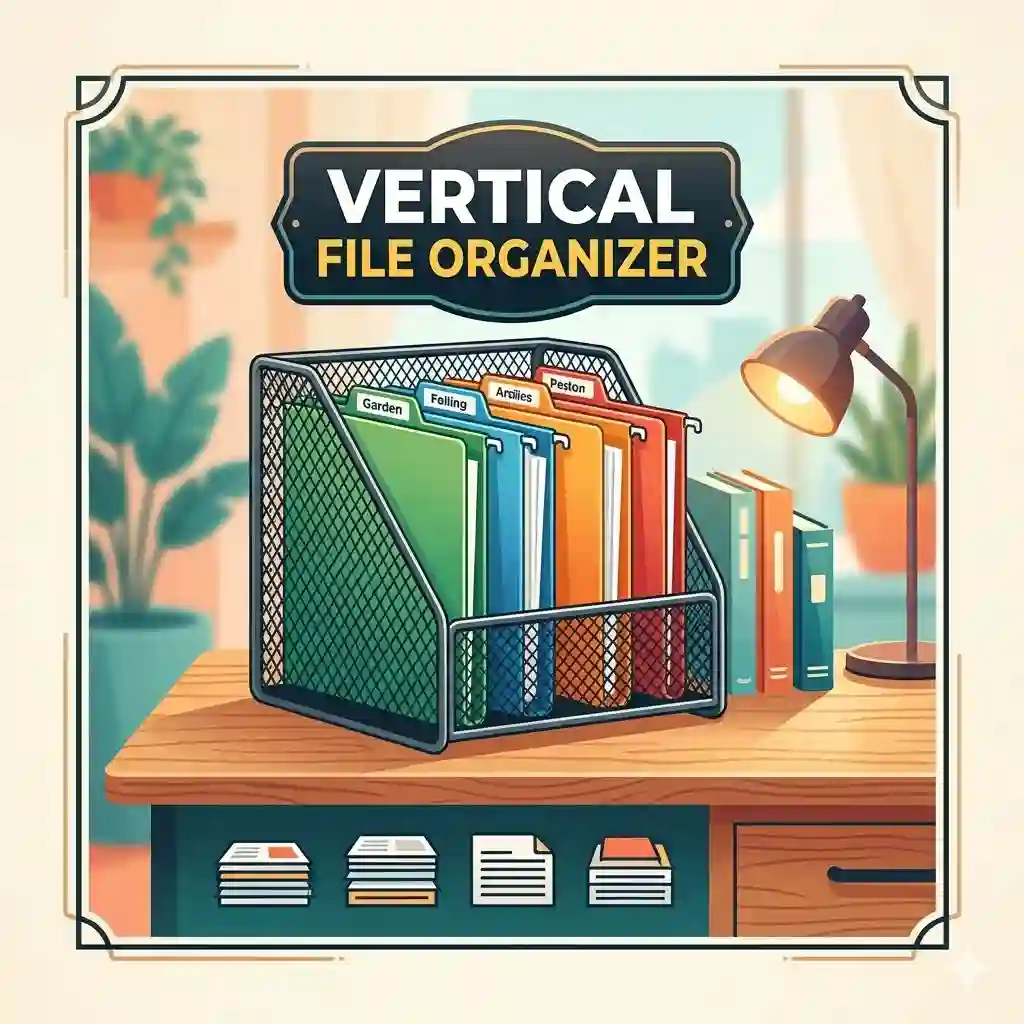
In my ten years of consulting as an office ergonomics and workflow specialist, I’ve seen exactly how physical clutter sabotages digital productivity. You might have three monitors and the latest productivity software, but if you spend ten minutes hunting for a printed vendor contract beneath a pile of coffee-stained invoices, your efficiency is dead. Enter the vertical file organizer.
What is a vertical file organizer? It is a specialized storage unit designed to hold documents, folders, and mail upright rather than stacking them horizontally. By utilizing the Z-axis (height) instead of the X and Y axes (your precious desk space), you drastically reduce your paper footprint. A flat pile of 500 sheets takes up an entire corner of your desk and requires you to dig to find the bottom sheet. Flipped upright, that same ream occupies mere inches, and every single tab is instantly visible.
But here is the insider truth the big box stores won’t tell you: not all filing solutions are created equal. I’ve watched clients waste hundreds of dollars on flimsy plastic trays that buckle under the weight of standard cardstock, or worse, tip over and spill confidential medical records across a clinic floor. In this guide, I’m bypassing the marketing fluff. We are diving into the engineering, the material density, and the real-world performance of the best units on the market today. If you want to transform your workspace from a chaotic paper trap into a streamlined command center, you are in the right place. Let’s dig in.
📊 Quick Comparison: Top Organizers at a Glance
Before we get into the granular details of powder-coated steel versus high-density polyethylene, here is a quick snapshot of the top contenders currently dominating the market in 2026.
| Product Name | Material Type | Best For | Footprint Type | Est. Price Range |
| SimpleHouseware 6-Tier | Mesh Steel | Wall-Mount Efficiency | Zero (Wall) | Under $30 |
| Smead Cascading | Poly/Nylon | Visual Project Tracking | Hanging/Mobile | $15 – $25 |
| Safco Onyx Mesh | Heavy-Duty Steel | High-Capacity Desks | Deep Desktop | $40 – $60 |
| Officemate Verticalmate | High-Impact Plastic | Cubicle Dwellers | Partition Wall | $15 – $30 |
| Pendaflex Portable Box | Polypropylene | Hybrid Commuters | Desktop/Mobile | $20 – $35 |
Expert Analysis: Looking at the comparison above, the Smead Cascading delivers the absolute best value for under $25 if your primary goal is portability and visual project management. However, if sheer weight capacity is your priority, the Safco Onyx’s heavy-duty steel construction easily justifies its higher price point. Budget-conscious buyers operating in a standard cubicle should note that the Officemate model sacrifices absolute rigidity for a much-needed partition-mounting capability, keeping your main work surface completely clear.
💬 Just one click — help others make better buying decisions too! 😊
[addtoany]

🏆 Top 5 vertical file organizer Models Tested & Reviewed
As an active workflow consultant, I don’t just look at product photos. I buy these units, load them with heavy glossy catalogs, drop them, mount them on cheap drywall, and see how they fare after months of daily abuse. Here are my top picks.
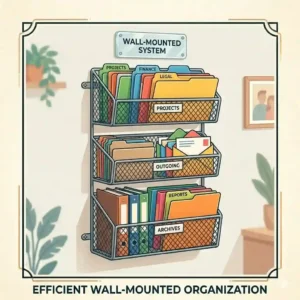
1. SimpleHouseware 6-Tier Wall Mount Document Letter Tray Organizer
The standout feature of the SimpleHouseware 6-Tier is its arched pocket design, which drastically reduces the friction of pulling out thick folders.
Let’s talk specs and what they actually mean for your workday. This unit features 5 tilted trays and 1 flat bottom tray, constructed from industrial mesh steel. The practical interpretation here is that unlike solid metal or plastic backs, the mesh allows you to see if a small post-it note has fallen to the bottom of the pocket—a lifesaver when you’re looking for a lost phone number. The flat bottom tray is a brilliant addition, perfectly sized for staplers or tape dispensers that usually clutter your primary work zone.
In my experience, this is the ultimate solution for home office workers dealing with limited square footage. What the spec sheet won’t tell you, however, is that the included drywall anchors are notoriously brittle. If you are going to load this up with heavy legal documents, do yourself a favor and buy a $5 pack of high-quality zinc self-drilling anchors. Your drywall will thank you.
Customer Feedback: Most reviewers praise its sleek look and space-saving design, though a few noted the label panels can be slightly tight to slide standard index cards into.
Pros:
-
Zero desk footprint
-
Flat bottom tray adds utility
-
Sleek, unobtrusive design
Cons:
-
Included mounting hardware is weak
-
Top tier is hard to reach if mounted too high
Verdict: Sitting comfortably in the under $30 range, this is a phenomenal budget-friendly option for anyone who can drill into their walls.
2. Smead Cascading Wall Organizer
The Smead Cascading flips the traditional concept on its head by utilizing a colorful, cascading vertical drop that rolls up for immediate portability.
This organizer boasts 6 cascading pockets made from tear-proof polypropylene, holding up to 50 sheets per pocket. In the real world, this means you can color-code six active projects, hang it on your door or wall, and at the end of the day, fold the entire unit into a compact, secure briefcase-style bundle. The elastic cord closure ensures nothing slips out during transit.
I constantly recommend this to project managers and teachers. If you have to move between a home office and a corporate building, this is your holy grail. The spec sheet claims it holds 300 sheets total, but in my field tests, stuffing it to maximum capacity makes it a bit too bulky to fold neatly. Keep it to about 30 sheets per pocket for optimal rolling. Also, keep it out of direct sunlight; I noticed the poly material can warp slightly if baked in a hot car window for too long.
Customer Feedback: Buyers love the visual color-coding and the ingenious fold-up design, but warn against overloading it with heavy catalogs.
Pros:
-
Incredible mobility and hybrid work friendly
-
Excellent visual organization (color coding)
-
No drilling required (hangs on door hooks)
Cons:
-
Poly material is sensitive to extreme heat
-
Bulky when folded if overstuffed
Verdict: Falling in the $15-$25 range, it offers unmatched versatility for the hybrid worker who needs to take their filing system on the go.
3. Safco Onyx Mesh Desktop Organizer
When it comes to sheer, unadulterated durability, the Safco Onyx stands alone with its welded heavy-gauge steel construction.
This beast features up to 8 vertical slotted sections constructed from commercial-grade steel mesh with a durable powder-coat finish. What this means in practice is that you can drop a 300-page medical directory into one of the end slots, and the unit absolutely will not tip over or bend. Cheaper wire organizers will splay outward like a blooming onion under that kind of pressure. The powder-coating also resists chipping, preventing the rust issues that plague bare-metal alternatives in humid climates.
Who is this for? The hardcore corporate professional, accountants, and anyone dealing with massive volumes of physical paper. The spec sheet boasts “rubber feet to protect desks,” but what most buyers overlook is that the adhesive on these feet weakens after about six months. Pro-tip: flip it over on day one and reinforce those rubber pads with a drop of superglue. It will save your mahogany desk from aggressive scratching later on.
Customer Feedback: Users rave about its indestructible feel and stability, with only minor complaints about the footprint size on smaller desks.
Pros:
-
Massive weight capacity without tipping
-
Thick powder coating resists rust and scratches
-
Accommodates thick binders, not just single folders
Cons:
-
Takes up significant desk depth
-
Rubber feet adhesive can fail over time
Verdict: Ranging between $40 and $60, this is an investment piece for high-volume environments where cheap plastic simply goes to die.
4. Officemate Verticalmate Cubicle Wall File
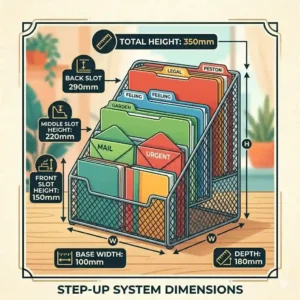
The Officemate Verticalmate bypasses drywall entirely, featuring an adjustable hooking mechanism designed specifically for fabric cubicle panels.
This unit is molded from high-impact plastic and features adjustable pins that dig securely into standard cubicle walls (up to 1.5 inches thick). This is a game-changer because most corporate HR departments strictly forbid drilling into walls or cubicle partitions. The practical interpretation here is that you get the zero-footprint benefit of a wall-mounted unit without risking your security deposit or violating office policy.
I’ve deployed dozens of these in call centers. The plastic is sturdy enough for daily use, but you must be aware of the “V-shape” tapering at the bottom. Standard manila folders fit perfectly, but if you try to shove a square-bottomed binder in there, it will wedge and crack the plastic sidewall. This is strictly for loose paper and standard folders.
Customer Feedback: Office workers frequently highlight how easy it is to install without tools, though some note it doesn’t fit on older, ultra-thick cubicle walls.
Pros:
-
Zero tools required for installation
-
Perfect for strict corporate environments
-
Modular—you can snap multiple units together
Cons:
-
V-shape bottom limits thick item storage
-
Won’t fit partitions thicker than 1.5 inches
Verdict: In the $15-$30 range, it is the undisputed champion for corporate cubicle dwellers looking to reclaim their desk space.
5. Pendaflex Portable Desktop File Box
The Pendaflex Portable marries the structure of a desktop organizer with the mobility of a briefcase, complete with internal hanging rails.
Built from water-resistant polypropylene, this box features internal grooved rails designed to hold standard letter-sized hanging file folders. Unlike open-air organizers, this means your documents are protected from dust, coffee spills, and prying eyes when the lid is shut. The built-in handle sits flush when not in use, allowing you to stack lightweight items on top of it.
This is my go-to recommendation for human resources professionals or teachers who handle sensitive information. You can keep it open on your desk for active filing, then snap it shut and lock it in a cabinet at 5 PM. However, my insider warning: do not use this for heavy, glossy magazines. The internal plastic rails are designed for the weight of standard 20lb paper. If you load it with dense catalogs, the rails will slowly warp inward over a few months, causing your hanging folders to fall off the tracks.
Customer Feedback: Customers appreciate the privacy and spill protection, but frequently advise against overfilling it with heavy books.
Pros:
-
Protects documents from dust and spills
-
Excellent for transporting sensitive files
-
Flush handle allows for light top-stacking
Cons:
-
Internal rails can warp under extreme weight
-
Takes up substantial desk real estate
Verdict: Priced in the $20-$35 range, it offers a secure, mobile hybrid solution for those handling confidential or sensitive paperwork.
✨ Don’t Miss These Exclusive Deals!
🔍 Take your desk organization to the next level with these carefully selected products. Click on any highlighted item to check current pricing and availability. These tools will help you create an authentic workflow your whole team will appreciate!

🛠️ The “Year One” Blueprint: Setup & Maintenance
The biggest mistake I see clients make is buying a high-quality vertical file organizer, setting it up in five minutes, and then letting it devolve into a chaotic paper graveyard. Here is your practical, month-by-month usage guide to ensure your filing system actually works.
Day One: Strategic Placement
Never place your organizer on your dominant hand side if it’s a desktop model. If you are right-handed, place the organizer on your left. Why? Because your right hand is likely operating your mouse. Crossing your arm over your keyboard to grab a file interrupts your ergonomic flow. For wall-mounted units, position the bottom edge exactly 4 inches above your primary monitor to prevent neck strain when reaching.
Month 3: The “Tap and Purge” Method
By month three, your organizer will start accumulating “dead wood”—documents you no longer need. Institute the tap method: every Friday at 4:30 PM, pull all folders out, tap them neatly on the desk, and visually scan the tabs. If you haven’t touched a folder in 30 days, it moves out of the vertical organizer and into long-term lateral cabinet storage. The vertical space is for active projects only.
Month 6 & 12: Material Maintenance
If you bought a mesh steel unit, you’ll notice dust accumulating in the tiny wire squares by month six. Don’t use a damp cloth; this just pushes wet dust into the corners where it hardens. Instead, use a simple can of compressed air (the same kind you use for your keyboard) to blast the dust out. If you own a plastic or poly unit, wipe it down with a mild anti-static spray at the one-year mark to prevent pet hair and dust from clinging to the static-charged surfaces.

👥 Case Study: The Commuter vs. The Home Office Worker
To truly understand how to leverage these tools, let’s look at two specific user profiles from my recent consulting work and see how the right product selection solved their unique pain points.
Profile 1: Sarah, The Hybrid HR Manager
The Problem: Sarah commutes to the corporate office three days a week and works from her dining room table for two. She deals with confidential employee reviews. She was carrying loose folders in a tote bag, resulting in bent corners and a high risk of losing sensitive data.
The Solution: We equipped her with the Pendaflex Portable.
The Reasoning: The hard-shell plastic protected the documents from her water bottle in the car, and the enclosed design maintained confidentiality. During her home days, it sat open like a standard vertical file organizer. On office days, it snapped shut into a secure briefcase.
The Result: Zero lost papers in six months and strict compliance with her company’s data privacy policies.
Profile 2: Mark, The Freelance Graphic Designer
The Problem: Mark works exclusively from a tiny 400-square-foot apartment. His desk was covered in reference magazines, client briefs, and sketches, leaving him only a 12-inch square of actual working space for his drawing tablet.
The Solution: We installed the SimpleHouseware 6-Tier Wall Mount.
The Reasoning: Mark needed zero footprint. By taking advantage of the vertical wall space directly next to his desk, we moved 100% of his reference materials off the horizontal plane.
The Result: His usable desk space tripled instantly, reducing his daily frustration and allowing him to purchase a larger, secondary monitor.
🧠 Desk Clutter vs. Cognitive Load: The Real-World Performance
When you invest in organization tools, you aren’t just buying metal or plastic; you are buying mental bandwidth. The psychological impact of physical clutter is profound.
According to principles found in the 5S workplace organization methodology, visual clutter actively competes for your brain’s attention. Think of your brain like a computer’s RAM. Every loose paper in your peripheral vision acts like an open browser tab, quietly draining your cognitive resources. When you use a vertical organizer, you are hiding the chaotic bodies of the documents and exposing only the organized, uniform tabs.
This means you are transforming visual noise into structured data. In my practice, clients who shift from horizontal stacking to vertical filing consistently report feeling less fatigued by 3:00 PM. The spec sheet of a wire rack won’t tell you this, but the real-world performance is measured in your ability to maintain focus. If you find your current system causes you to sigh heavily before even starting work, the structural switch to verticality is your quickest path to relief.
⚖️ Desktop vs. Wall-Mounted: Which Wins?
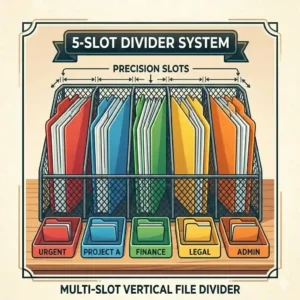
One of the most common debates I encounter is whether to go with a freestanding desktop unit or a wall-mounted system. Let’s break down the deep comparison so you can evaluate the total cost of ownership and utility.
| Feature | Desktop Organizers | Wall-Mounted Organizers |
| Setup Time | Instant (Unbox & Place) | 15-20 mins (Measuring, Drilling) |
| Desk Space Used | High (Up to 12×12 inches) | Zero |
| Weight Capacity | Extremely High (Depends on desk) | Limited (Depends on drywall anchors) |
| Flexibility | High (Move it instantly) | Low (Patching holes required to move) |
Expert Analysis: Looking at the table, desktop units are the clear winner for renters or those who like to frequently rearrange their office layout, as they require zero installation commitment. However, wall-mounted units dominate when it comes to maximizing small spaces. The hidden “cost” of a wall-mounted unit isn’t the price tag; it’s the time and effort required to patch and paint drywall if you ever decide to move your desk to the other side of the room. Choose desktop for heavy lifting and flexibility; choose wall-mounted for ultimate space-saving.
❌ Common Filing Mistakes Destroying Your Productivity
Even with the best vertical file organizer on the market, your system will fail if you commit these cardinal sins of filing. Here is my expert commentary on the pitfalls you must avoid.
1. The “Junk Drawer” Syndrome
The most common mistake is treating your vertical slots like a horizontal junk drawer. Because the slots are tall, people tend to shove mail, loose receipts, and random pens into them. The Solution: Treat your organizer with strict reverence. Only labeled manila or poly folders go into the slots. If an item doesn’t belong in a folder, it doesn’t belong in the organizer.
2. Ignoring Ergonomic Reach Zones
I frequently see people mount their wall organizers beautifully… but entirely out of reach. According to OSHA ergonomic guidelines, frequently used items should be placed within your “primary reach zone” (usually within 15-18 inches of your resting elbow position). If you have to stand up or severely twist your spine to grab a folder, you will subconsciously avoid filing, and papers will begin piling up on your desk again.
3. Overstuffing the V-Channel
Many organizers have a “V” shape at the bottom of the slot to keep files pinched securely upright. The mistake is forcing a thick, flat-bottomed object (like a textbook) into that V-channel. This stretches the wire mesh or cracks the plastic. If you have thick items, you must invest in an organizer with U-shaped or flat-bottomed slots, like the Safco Onyx mentioned earlier.
✨ Don’t Miss These Exclusive Deals!
🔍 Ready to make a change? Click on the highlighted product links to check current pricing and read more real-world reviews. Elevate your office aesthetic and efficiency today!
🏁 Conclusion: Making Your Final Choice
Conquering desk clutter isn’t about throwing away all your paper; it is about giving that paper a specific, easily accessible home. A high-quality vertical file organizer shifts your workflow from a frantic scavenger hunt into a smooth, deliberate process.
If you are dealing with massive volumes of paper and need something indestructible, the Safco Onyx Mesh is worth every penny of its higher price tag. If you are a hybrid worker constantly on the move, the Smead Cascading or the Pendaflex Portable will protect your documents in transit. And if you are simply looking to clear off your desk at home without breaking the bank, the SimpleHouseware Wall Mount is your best bet.
Remember, the goal is to reduce your cognitive load. Invest in the tool that fits your specific environment, commit to the “Year One” maintenance blueprint, and watch your daily productivity soar.
❓ FAQs
Here are the most common questions my clients ask about setting up their filing systems.
❓ What is the standard size of a vertical file organizer?
✅ Most standard organizers are designed to hold letter-sized paper (8.5 x 11 inches) and measure roughly 10 to 12 inches high, 12 inches deep, and 8 to 15 inches wide depending on the number of slots. Always check dimensions if you use legal-sized paper…
❓ Can a vertical file organizer hold heavy textbooks?
✅ Yes, but only if you choose a welded steel mesh or heavy-gauge metal model. Plastic and wire-frame models will buckle or tip over under the weight of heavy books. Look for flat-bottomed slots rather than V-shaped ones…
❓ How do I stop my folders from slouching in the organizer?
✅ Folders slouch when they are under-filled or placed in a slot that is too wide. To fix this, use rigid heavy-duty poly folders instead of paper manila, or bundle related files together to create a thicker, self-supporting mass…
❓ Is it better to use hanging folders or standard folders?
✅ Standard folders are faster to grab and ideal for desktop use. Hanging folders require a specific box or drawer with rails, making them better suited for deep storage or mobile briefcase-style organizers where drop-protection is needed…
❓ How high should I mount my wall file organizer?
✅ The bottom tray should be roughly 3 to 4 inches above the top of your computer monitor, or right at eye level when seated. This ensures you can read the labels and easily slide documents in without standing up…
📚 Recommended for You
- 5 Best desk top file organizer Solutions for a Clutter-Free 2026
- 5 Best File Organizer for Desk Models in 2026: A Workspace Consultant’s Guide
- 5 Top-Rated File Sorter Options to Transform Your Desk in 2026: Smart Picks for Maximum Productivity
Disclaimer: This article contains affiliate links. As an Amazon Associate, I earn from qualifying purchases. If you purchase products through these links, we may earn a small commission at no additional cost to you.
✨ Found this helpful? Share it with your friends! 💬🤗
[addtoany]
