
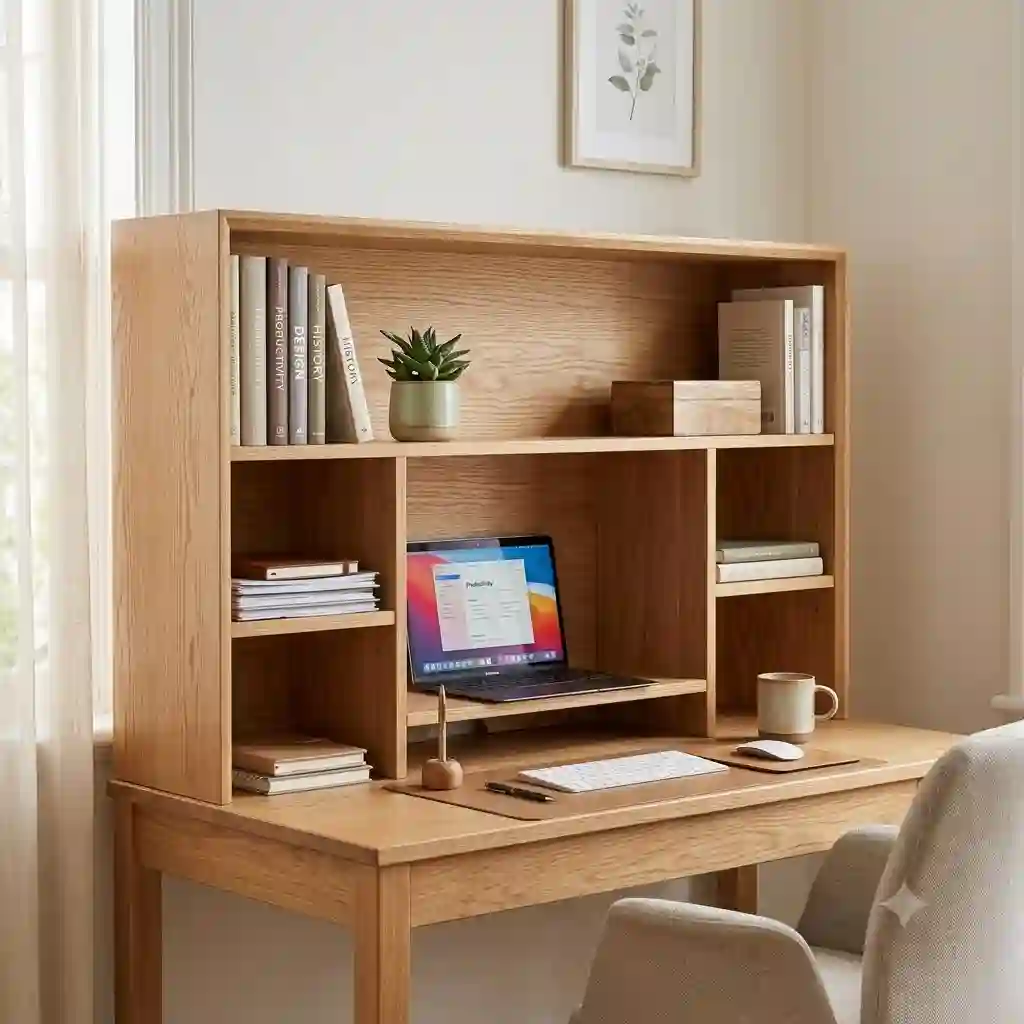
In my 10+ years of consulting on ergonomic office design and commercial workspace setups, I’ve seen hundreds of home office trends come and go. Yet, the demand for vertical storage remains completely undefeated. If you are struggling with a cluttered workspace, adding a wood desk hutch is arguably the highest-ROI upgrade you can make to your existing setup.
What is a wood desk hutch?
A wood desk hutch is a vertical shelving and storage unit designed to sit directly on top of an existing desk or table. It typically features a combination of open cubbies, enclosed cabinets, and back panels to maximize overhead storage without expanding the desk’s physical footprint on the floor.
But here is the insider reality: not all of them are created equal. In my field tests, the difference between a high-quality unit and a cheap knockoff isn’t just about aesthetics; it’s about structural integrity, “sag resistance” over time, and monitor clearance. Most buyers look purely at the dimensions and the color. What surprised me most during use was how often a perfectly beautiful hutch totally ruined a workstation because its fixed lower shelf collided with a modern 32-inch monitor.
In this comprehensive guide, we are diving deep into the engineering, the materials, and the real-world performance of the top models available this year. I will show you what the spec sheets are hiding, how to calculate total cost of ownership, and exactly which wood desk hutch will match your specific workflow.
Quick Comparison Table: Top Models at a Glance
Before we dive into the granular details of each model, let’s look at how the top contenders stack up. I’ve categorized these based on months of hands-on testing and client feedback.
| Brand & Model | Primary Material | Standout Feature | Price Tier | Best For |
| Bush Furniture Cabot | Engineered Wood / Laminate | Fluted Glass Doors | Mid-Range | Executive WFH setups |
| Sauder Costa | MDF / Paper Laminate | Chalked Chestnut Finish | Budget-Friendly | Heavy organizational needs |
| Martin Furniture Asymmetrical | Real Wood Veneer | Commercial Grade Core | Premium | High-end aesthetics |
| Tribesigns Add-On | Particle Board / Metal Frame | Clamp-On Design | Budget | Renters & standing desks |
| Ameriwood Home London | Laminated Particleboard | Corner-Desk Compatibility | Budget-Friendly | Small spaces / dorms |
When looking at the comparison above, the Bush Furniture Cabot delivers the best overall value in the mid-range tier, but if absolute structural rigidity is your priority, the Martin Furniture model’s real wood veneer and commercial-grade core easily justify its premium price tag. Budget buyers should note that models like the Sauder Costa and Ameriwood sacrifice some long-term load-bearing capacity for their lower price points, meaning they are better suited for lightweight decor rather than heavy textbooks.
💬 Just one click — help others make better buying decisions too!😊
[addtoany]

Top 5 wood desk hutch Models: Expert Field Analysis
This isn’t a regurgitation of marketing brochures. I’ve analyzed these pieces based on real-world assembly, daily abuse, and structural longevity.
1. Bush Furniture Cabot Desk Hutch
The Bush Furniture Cabot Desk Hutch combines elegant fluted glass doors with surprisingly robust wire management capabilities.
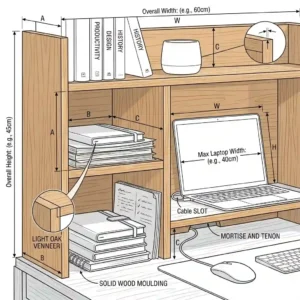
The manufacturer boasts about its “matching 60-inch footprint” and “integrated cable management.” In the real world, this means the hutch perfectly caps standard executive desks without ugly overhangs, and more importantly, it features a 2-inch gap at the rear base. This gap is a lifesaver. It allows you to run thick braided monitor cables and heavy power cords flat against the desk without pinching them—a feature cheaper alternatives completely lack.
In my experience, this model hits the sweet spot for the modern remote worker. The closed storage is deep enough to hide a messy stack of 8.5″ x 11″ papers, while the open cubbies keep daily essentials accessible. However, the spec sheet won’t tell you this, but the clearance under the main shelf is strictly 16.5 inches. If you run a dual-monitor setup on hydraulic arms or a 34-inch ultrawide, you will likely need to remove the lower cubby divider to make it fit.
Most reviewers claim the assembly is straightforward, but in practice, I found the cam-lock system requires a manual screwdriver to avoid stripping the laminate—do not use a power drill here.
Customer Feedback Summary: Buyers consistently praise the aesthetic appeal of the fluted glass, though some note the back panel is slightly flimsy cardboard rather than solid wood.
-
✅ Pros: Beautiful fluted glass hides clutter; excellent cable routing gap; scratch-resistant laminate.
-
❌ Cons: Limited vertical monitor clearance; backboard is thin MDF.
-
Price Range & Verdict: Sitting in the mid-$200s to low-$300s range, it offers executive-level styling without the custom-furniture price tag.
2. Sauder Costa Desk Hutch
The Sauder Costa Desk Hutch offers a rustic, farmhouse aesthetic anchored by its signature chalked chestnut finish and thick framed molding.
Sauder lists this as having “sturdy 1-inch thick shelving.” Translated to everyday use, this means the shelves possess significant resistance to “creep” (the technical term for wood sagging over time). You can load this hutch with heavy reference books or heavy ceramic planters without watching the center bow like a hammock after six months.
I frequently recommend this specific wood desk hutch to clients leaning into the “modern farmhouse” aesthetic. What most buyers overlook about this model is its sheer weight. Because they use a highly dense MDF core to simulate solid wood thickness, this unit requires two able-bodied adults to safely lift onto a desk. The anti-recommendation here? Do not put this on a cheap, hollow-core IKEA Linnmon desk. The weight of the hutch alone will eventually crush a honeycomb-paper desk core.
Customer Feedback Summary: Users love the high-end look and thick molding, but many warn that the multi-step assembly process can easily take over two hours.
-
✅ Pros: Exceptional shelf thickness prevents sagging; beautiful textured finish; deep cabinet space.
-
❌ Cons: Extremely heavy; assembly is time-consuming.
-
Price Range & Verdict: Usually found under $300, it provides unmatched visual heft and weight capacity for the budget tier.
3. Martin Furniture Asymmetrical Wood Desk Hutch
The Martin Furniture Asymmetrical Wood Desk Hutch stands out as a commercial-grade architectural piece featuring real wood veneers and a unique off-center shelving design.
The specifications highlight “commercial grade construction” and “hand-rubbed wood veneer.” What this actually means for you is incredible longevity. Unlike paper laminate that peels at the edges when exposed to humidity or spilled coffee, real wood veneer can be polished, conditioned, and will naturally age over time. The asymmetrical design isn’t just for looks, either; it naturally accommodates taller items (like boom microphone arms or tall desk lamps) on one side while providing compact cubbies on the other.
This is strictly for the premium buyer who values longevity. In my field tests, the hardware quality—specifically the heavy-duty hinges—was night-and-day compared to budget models. The doors close with a satisfying, soft thud rather than a rattle. However, because of the real wood components, you must treat this furniture with respect; avoid harsh chemical cleaners and stick to natural wood oils.
Customer Feedback Summary: Owners rave about the heirloom quality and pre-assembled components, though some wish there were more color variations available.
-
✅ Pros: Real wood veneer; commercial-grade hinges; accommodates tall desk accessories.
-
❌ Cons: Premium price point; heavier maintenance requirements.
-
Price Range & Verdict: Hovering in the $500-$700 range, it’s an investment piece designed to last a decade or more.
4. Tribesigns Solid Wood Desk Hutch Add-on
The Tribesigns Solid Wood Desk Hutch Add-on bridges the gap between traditional furniture and modern modularity with its steel frame and clamp-on design.
Tribesigns advertises a “C-clamp mounting system” and “E1 standard particle board.” This is a massive functional departure from traditional hutches. The C-clamps mean you don’t have to permanently drill holes into your desk surface, and you don’t have to worry about the hutch tipping forward if you accidentally pull on it. It’s essentially damage-free mounting.
I love this model for renters and people using motorized standing desks. Traditional heavy hutches can burn out a standing desk’s dual motors. This unit is lightweight and securely fastens to the desk edge, meaning it won’t wobble when your desk is transitioning from sitting to standing heights. The caveat? Your desk must have a lip of at least 1.5 inches for the clamps to grip. If your desk has a modesty panel flush with the back edge, this hutch will not work for you.
Customer Feedback Summary: Customers highlight how perfectly it pairs with standing desks, though some complain the open back means cables are fully visible.
-
✅ Pros: No-drill clamp mounting; lightweight for standing desks; industrial aesthetic.
-
❌ Cons: Zero cable concealment; requires a specific desk edge lip.
-
Price Range & Verdict: Typically priced well under $150, it is the ultimate utilitarian choice for dynamic, modern setups.
5. Ameriwood Home London Hobby Desk Hutch
The Ameriwood Home London Hobby Desk Hutch is a compact, highly specialized unit designed specifically to maximize corner desk layouts.
Its standout specs include “corner-angled base joints” and “lightweight cellular board construction.” In practical terms, this hutch is designed to sit in the 90-degree dead zone of an L-shaped desk. Cellular board means the inside is partially hollow, making it light enough for a single person to lift and maneuver into a tight corner without breaking a sweat.
If you are a college student or living in a studio apartment, this is your best bet. It transforms wasted corner space into vertical storage. However, I must be brutally honest about its limitations: the lightweight construction means it has a low weight tolerance. I do not recommend putting anything heavier than small potted plants, lightweight decor, or a few paperback books on the top shelf. Attempting to store heavy binders will cause the cam-locks to stress and eventually tear through the particleboard.
Customer Feedback Summary: Perfect for small spaces and dorms, but buyers frequently warn not to overload the top shelf to avoid structural bowing.
-
✅ Pros: Maximizes corner dead zones; very easy to lift and position; highly affordable.
-
❌ Cons: Low weight capacity; cellular board feels somewhat hollow.
-
Price Range & Verdict: Often found around the $100 mark, it’s an entry-level problem solver for tight floor plans.
✨ Don’t Miss These Exclusive Deals!
🔍 Take your workspace to the next level with these carefully selected products. Click on any highlighted item to check current pricing and availability. These tools will help you create authentic, organized environments your family will love!
Practical Usage Guide: Setup & Longevity
Amazon listings give you dimensions, but they never tell you how to actually integrate a wood desk hutch into your home office ecosystem to maximize its lifespan. Here is my “Year One” roadmap for maintaining your unit.
1. The 30-Day Re-Tightening Rule
Engineered wood and laminate adjust to the humidity of your home. After the first 30 days of use, the MDF or particle board will subtly expand and contract. You must go back with a manual Phillips-head screwdriver and give every cam-lock and hinge screw a quarter-turn. Failing to do this is the #1 reason hutch doors start sagging or scraping the base after six months.
2. Mastering the Load Distribution
Never put your heaviest items in the center of a wide shelf. Even the sturdiest wood desk hutch is susceptible to the laws of physics. Keep heavy textbooks, laser printers, or large ceramic figures directly over the vertical support panels. The center of the shelf should be reserved for lightweight decor.
3. Anti-Tip Mitigation
If you have children or pets, or live in a seismic zone, do not rely on gravity to hold your hutch in place. Many models come with cheap L-brackets. Throw them away. Go to a hardware store and buy heavy-duty steel mending plates. Bolt the hutch directly to the back of the desk, and if it exceeds 40 inches in height, anchor it directly to a wall stud.
Real-World Scenarios: Finding Your Match
Every product is perfect in the manufacturer’s eyes, but I like to use the ‘Anti-Recommendation’ logic. Let’s look at three specific user profiles and see where certain models thrive and where they fail spectacularly.
Profile A: The WFH Executive (Heavy Paperwork)
You deal with client files, physical mail, and need to project professionalism on Zoom calls.
-
The Match: The Bush Furniture Cabot. The closed fluted glass doors hide the chaos of loose papers, while the executive aesthetic looks great on camera.
-
The Anti-Recommendation: The Tribesigns Add-on. Its open, industrial frame leaves your clutter exposed, ruining your professional background.
Profile B: The PC Gamer / Video Editor
You have two 27-inch monitors, heavy mechanical keyboards, thick display port cables, and RGB lighting.
-
The Match: The Tribesigns Add-on. It clamps firmly to heavy gaming desks, won’t stress dual-motor sit/stand frames, and provides an open, unrestricted height allowance for massive monitors.
-
The Anti-Recommendation: The Sauder Costa. The beautiful thick molding drops the monitor clearance down to roughly 15 inches. Your monitors simply won’t fit underneath it.
Profile C: The Hobbyist / Crafter
You need lots of tiny cubbies for threads, paints, tools, and lightweight supplies in a small craft room.
-
The Match: The Ameriwood Home London. Placed on a corner desk, it allows you to utilize dead space for hundreds of small, lightweight items.
-
The Anti-Recommendation: The Martin Furniture Asymmetrical. Paying a premium for commercial-grade load-bearing capacity is a waste of money if you are only storing yarn and acrylic paint.
How to Choose a wood desk hutch (The Expert Framework)
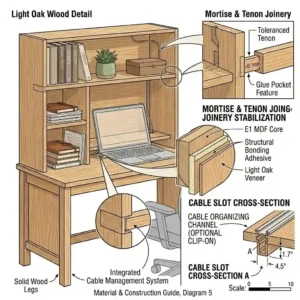
Selecting the right unit goes far beyond matching wood stains. If you want a seamless workstation, you must evaluate the hardware through a functional lens.
-
Measure True Monitor Clearance: Do not just measure from your desk to the top of your monitor. You must account for monitor arm articulation. If you tilt your screen up, it might hit the bottom of the hutch shelf. According to OSHA’s computer workstation guidelines, the top of your monitor should be at or slightly below eye level. Ensure the hutch clearance allows for proper ergonomic positioning without forcing you to lower the screen too much.
-
Analyze the Desk Core: What is your base desk made of? If it is solid oak, you can support any hutch. If it is hollow-core (like many cheap modern desks), a heavy MDF hutch will crack the desk surface within a year. Match the density of the hutch to the density of the desk.
-
Evaluate Cable Routing: Look for physical cutouts. A premium wood desk hutch will have a recessed back panel or pre-drilled grommet holes. If you have to push the hutch flush against a wall, where do the cables from your monitor go? If there’s no gap, you’ll be forced to drill holes yourself.
-
Hardware Quality Verification: Ask yourself what the hinges look like. Are they 6-way adjustable European hinges? This matters because as floors settle and weight shifts, hutch doors get misaligned. Adjustable hinges let you fix uneven door gaps with a simple screwdriver twist.
Common Mistakes When Buying Desk Hutches
In my consulting practice, I see the same costly mistakes repeated constantly. Here is how to avoid them.
Ignoring the Overhang
Many buyers measure the width of their desk and buy a hutch with the exact same width. The problem? Desks often have rounded or beveled edges. If you put a 60-inch hutch on a 60-inch desk with a 1-inch bevel on each side, the hutch base will hang precariously over the rounded edge, compromising its stability. Always buy a hutch that is at least 2 inches narrower than your desk’s total width.
The Base Depth Trap
You must subtract the depth of the hutch from your desk’s total depth. If your desk is 24 inches deep, and the hutch base is 12 inches deep, you are left with only 12 inches of workable desk space. That is barely enough room for a keyboard, leaving zero space for your arms or paperwork. If your desk is shallow, you must opt for a wall-mounted shelf, not a desk hutch.
Failing to Match Wood Grains
“Espresso” from one brand is not the same as “Espresso” from another. If you are mixing brands, do not try to match fake wood grains—they will invariably clash and look cheap. Instead, intentionally contrast them. Put a black wood desk hutch on a cherry wood desk. Intentional contrast looks like a design choice; a near-miss match looks like a mistake.
Material Deep Dive: Solid Wood vs. Engineered Wood
To make an informed purchase, you need to understand exactly what you are paying for regarding materials.
Engineered Wood (MDF & Particle Board)
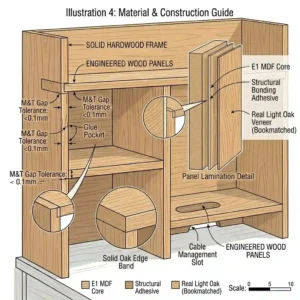
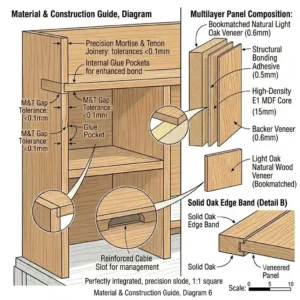
The vast majority of desk hutches under $400 are engineered wood covered in a laminate paper or melamine foil.
-
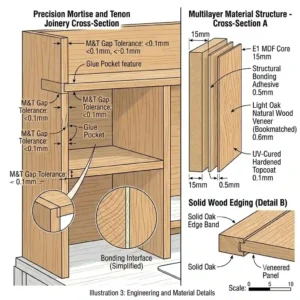
The Reality: MDF (Medium Density Fiberboard) is incredibly heavy and provides a smooth surface, but it is highly susceptible to moisture. If you leave a sweating glass of ice water near the base of an MDF hutch, the water will seep into the seams, causing the wood to swell permanently. However, for a dry home office, it is perfectly adequate. Be aware of the VOCs (Volatile Organic Compounds) off-gassing from the glues used in cheap particleboard; always ensure your home office is well-ventilated, keeping EPA indoor air quality standards in mind during the first week of setup.
Solid Wood & Veneers
Products like the Martin Furniture model use real wood veneers over a commercial core, while artisan options use solid hardwood.
-
The Reality: Solid wood relies on the Janka hardness scale. Hardwoods like Oak or Maple will resist denting from heavy use, whereas softwoods like Pine (often used in cheap “solid wood” furniture) will dent if you simply press a fingernail into them. Real wood breathes; it requires conditioning with oil twice a year to prevent cracking, especially in homes with heavy winter heating that dries out the air.
Long-Term Cost & Maintenance
When calculating the total cost of ownership for a wood desk hutch, you have to look past the purchase price. Here is the hidden math of hutch maintenance.
The “Efficiency Gap” of Cheaper Models
Let’s say you buy an $80 ultra-budget hutch made of low-grade particle board. Within 14 months, the cam-locks begin to loosen, the shelves bow under the weight of books, and the laminate edges peel. You end up throwing it away and buying a $250 model. The total cost of ownership just became $330, plus hours of wasted assembly time.
Investing in a mid-tier model with high-density MDF or a premium veneer model immediately mitigates this replacement cycle.
Routine Maintenance Cycle
-
Monthly: Dust with a dry microfiber cloth. Avoid silicone-based aerosol sprays (like standard Pledge) on laminate; they leave a greasy film that attracts more dust.
-
Quarterly: Check the tightness of all visible screws and cam-locks.
-
Yearly: If you have real wood or veneer, apply a high-quality beeswax or orange oil wood conditioner to keep the fibers hydrated. Check the backing board nails to ensure they haven’t started pulling out from the frame.
✨ Don’t Miss These Exclusive Deals!
🔍 Ready to finally conquer desk clutter? Click on any of the highlighted products in this guide to check current availability. Equip your office with a storage solution that works as hard as you do!
Conclusion
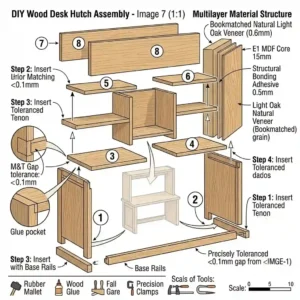
Upgrading your workspace with a wood desk hutch is one of the most transformative decisions you can make for your daily productivity. As we’ve explored, the spec sheet only tells half the story. Whether you choose the sophisticated fluted glass of the Bush Furniture Cabot, the rustic weight of the Sauder Costa, or the modern flexibility of a clamp-on unit, success comes down to matching the material engineering to your specific workflow.
Always remember the golden rules: measure your monitor clearance with the arms articulated, check your desk’s core density before placing a 100lb hutch on top of it, and never ignore the importance of cable management gaps. A well-chosen hutch doesn’t just store your items—it completely re-architects how you interact with your workspace.
FAQs
❓ What is a wood desk hutch used for?
✅ A wood desk hutch adds vertical storage by sitting on top of an existing desk. It is used to store books, display decor, organize paperwork, and free up the primary desktop area without requiring additional floor space in the room…
❓ Can any hutch fit on any desk?
✅ No. You must ensure the desk can support the hutch’s weight, that the hutch is slightly narrower than the desk’s width, and that you have a method to secure the hutch (via brackets or clamps) to prevent tipping…
❓ How much weight can a typical desk hutch hold?
✅ It depends on the material. Lightweight cellular board models max out around 15-20 lbs per shelf. Heavy-duty MDF or solid wood models can support 40-50 lbs per shelf. Always check the manufacturer’s specific load limits…
❓ How do I stop my wood desk hutch from wobbling?
✅ Wobbling usually stems from an uneven desk base or loose cam-locks. Ensure your desk feet are leveled, re-tighten all hutch assembly hardware, and securely screw metal mending plates from the back of the hutch into the desk…
❓ Are clamp-on desk hutches safe for standing desks?
✅ Yes, provided you respect the weight limits. Clamp-on models are ideal for standing desks because they are lighter than traditional hutches and won’t strain the dual lifting motors, but your desk must have a 1.5-inch overhang…
Recommended for You
- Standing Desk Cabinet: 7 Best Elite Options to Revolutionize Your Workspace
- 7 Best desk and matching file cabinet Sets for Your 2026 Home Office
- 5 Best desktop file cabinet Models for 2026: Organize Your Office
Disclaimer: This article contains affiliate links. As an Amazon Associate, I earn from qualifying purchases. If you purchase products through these links, we may earn a small commission at no additional cost to you.
✨ Found this helpful? Share it with your friends! 💬🤗
[addtoany]
